
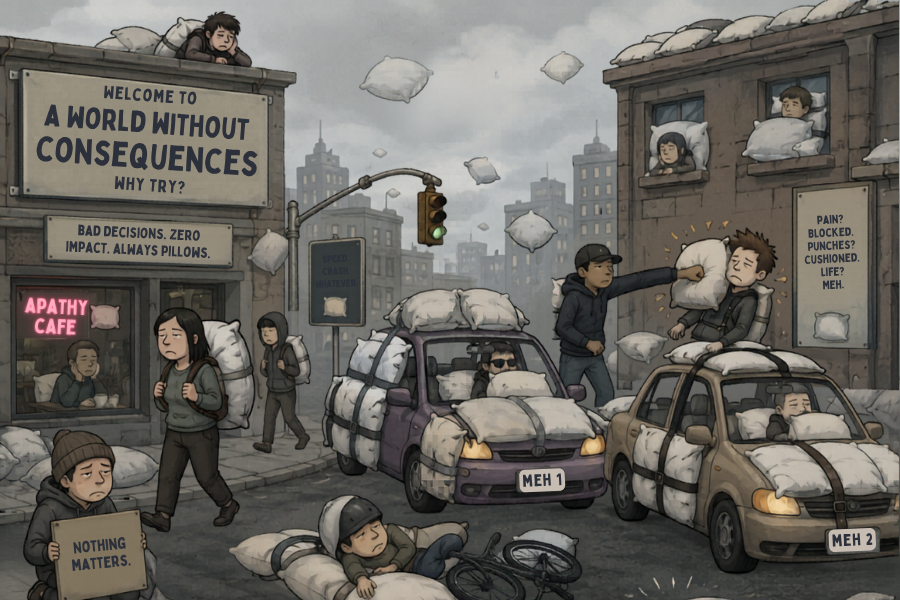
A world worse than one where evil abounds is one where evil is unrecognizable.
I get asked all the time, if God is good, why does evil exist? Why does He let people suffer? I understand this question. I’ve known pain. I see evil. I feel its weight.
Yet, intellectually, the problem of evil isn’t what it once was. Alvin Plantinga, among others, showed long ago that the logical problem of evil fails. All that is required is the possibility that God has a morally sufficient reason for allowing evil, and human freedom is a powerful one. Much of the pain we know flows from the evil mankind produces, and to eliminate all evil would require eliminating that freedom. One cannot be free while being forced to do only what is right.
That may satisfy us intellectually. But it doesn’t answer the deeper question: why this much evil? Why this degree of suffering? Why not limit it? Why not stop the worst atrocities, the most devastating diseases, the tragedies that seem so far beyond what is necessary for freedom? Surely, God could create a free world without holocausts and hurricanes.
Well, let’s think about it.
What would the world be like if the worst evils never occurred, or if suffering never fully followed our actions? Before you say “heaven on earth,” slow down. What would we come to believe about ourselves if we never experienced the real consequences of our choices or the limits of our nature?
First, we would believe we are something like gods.
Imagine a world where the most powerful forces of nature could never harm you—where fire doesn’t burn you, gravity never breaks bones, and nothing in creation can truly threaten your life. Imagine a world where our minds never fail, never misunderstand, and never arrive at false conclusions.
In that world, we would not see ourselves as limited or dependent. We would see ourselves as invulnerable, self-sufficient—something closer to gods than creatures. But we are not gods, and it would not be loving for God to create a world that deceives us about who we are.
Second, and more importantly, the nature of good and evil would collapse.
Imagine a world where evil never fully lands, where hatred never truly wounds, betrayal never really breaks trust, and violence never destroys—a world where every consequence is softened, every outcome restrained, every evil act quietly absorbed before it can reveal what it actually is.
In that world, what would we believe about evil?
I think we wouldn’t see evil as destructive and deadly. We would see it as manageable, even trivial—something far less serious than it truly is. But evil is not trivial, and it would not be loving for God to create a world where sin is allowed to masquerade as mischievous.
This kind of world would not just be different—it would be false. A kind of moral illusion, where actions appear real but carry no real weight, where cause and effect are severed, where truth itself is quietly distorted. And this is the world God would create if He constantly intervened to prevent the worst outcomes of evil.
In a world where you have the freedom to choose evil but that choice does not produce anything of real consequence, the moral structure of reality itself would collapse. Evil would exist, but it would be hidden. And a world where evil is hidden is far more dangerous than a world where it is seen for what it is.
God loves us enough not to deceive us. God allows us to see. He lets us see what we are capable of. He lets us see what evil does when it is fully grown. Indeed, He must let us see the cost of sin, not as an abstract idea but as a lived reality, in order that we can truly know ourselves and truly understand our relationship with Him. We are creatures. He is the Creator. We are broken. He is the healer. We are sinners. He is the Savior.
In Him we live and move and have our being, and in Him our deepest joys find their rest. We are entirely dependent upon Him. And if God created a world that tricked us into thinking we are self-sufficient, He would have robbed us of that which truly brings life.
This does not make the pain easier. It does not lessen the weight of suffering. But it does give us hope. The God who refuses to deceive us about evil is the same God who entered into it, bore its full weight, and refused to let it have the final word. And one day, in His presence, every wound that evil has carved into us and into this world will be healed.

Michael C. Sherrard
Michael C. Sherrard is the president of Apologetics, Inc., the author of Why You Matter and Relational Apologetics, and faculty at Summit Ministries.
5 thoughts on “Why Doesn’t God Stop the Worst Evils? ”
Well said, Mike!!
Thanks, Dan!
Hi Mr Sherrard,
I enjoyed your discussion of “Why Doesn’t God Stop the Worst Evils?”, especially your emphasis on the necessity for God to allow our free will to make choices and experience consequences.
These common concerns you mentioned are typical of a common assumption I seldom see addressed:
“Why this much evil? Why this degree of suffering? Why not limit it?”
Virtually always left unquestioned is the possibility that God is *already* preventing or limiting a great deal of evil that would otherwise afflict us. When God removed his protecting hand from his people in Old Testament times, they were afflicted by far worse problems than they had been experiencing before. And something like that may be happening every day, that God is protecting us from evils of which we’re never aware. There is no way to know on this side of eternity, but I think it definitely needs to be considered in any consideration of this topic.
Have a great day!
— Dennis in West Virginia
Great point!
Great article, Mike. I hadn’t ever considered the concept that God could have chosen to anesthetize mankind to the pain of evil. If that were the case, it would also have prevented suffering from fueling increases in what our world needs most – prayer and compassion.